Mixture of experts
284B parameters. No GPU.
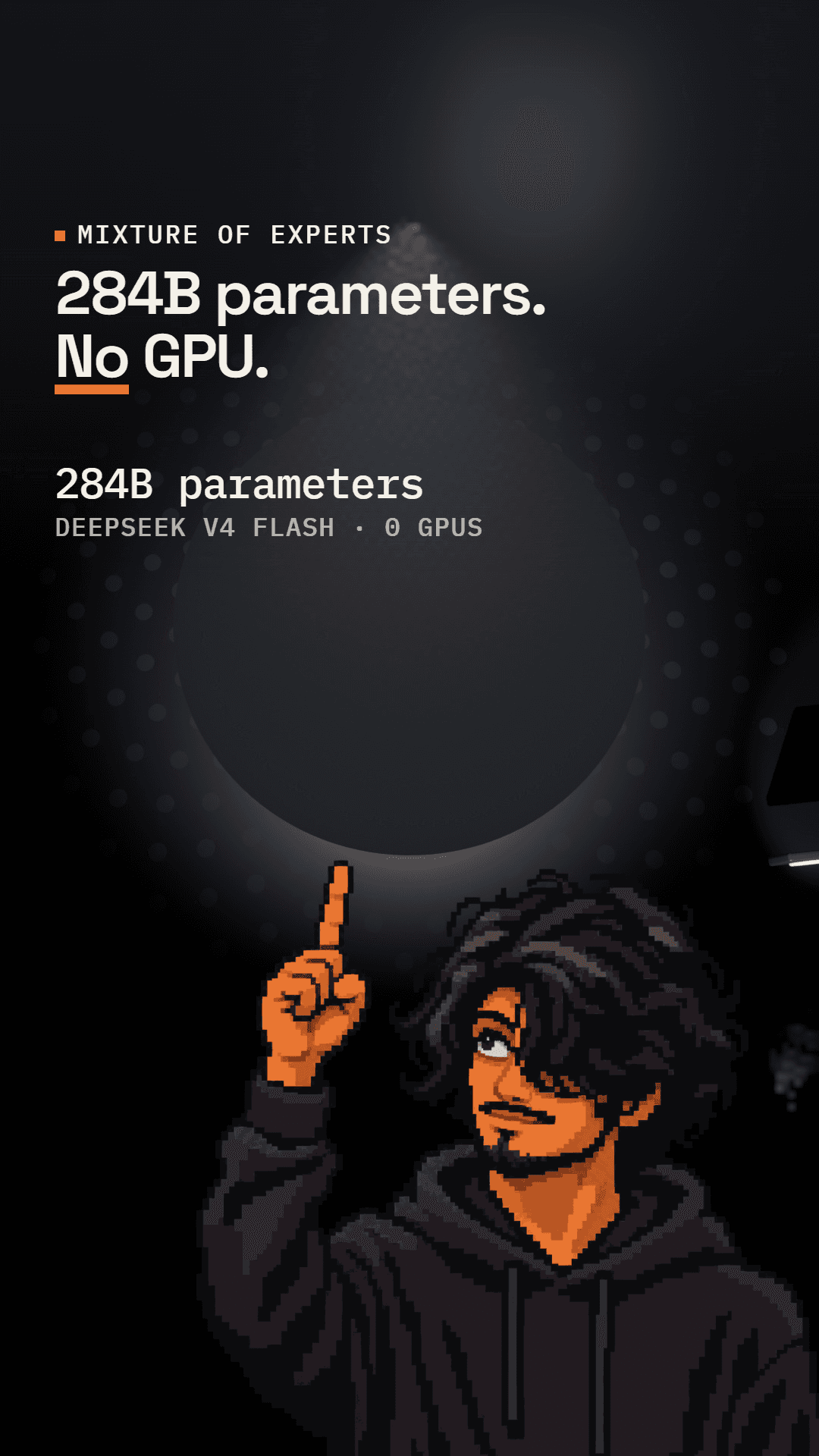
Someone ran DeepSeek V4 Flash, a 284 billion parameter model, on a PC with 64 GB of RAM and no graphics card. Two things make it work: squeezing the model hard, and only using a few experts per token.
By Laksh2 min readAI infrastructure and engineering
 Watch the reel43 s · InstagramWatch ↗
In short
DeepSeek V4 Flash has 284B parameters but is a mixture of experts, so only about 13B do any work per token. As released it's about 160 GB. A community build squeezed it to 1.71 bits per weight on average (about 57 GB), which fits in 64 GB of RAM, and the author reports around ten tokens a second on a CPU with no GPU.
DeepSeek V4 Flash has 284 billion parameters. Someone got it running on a PC with 64 GB of RAM and no graphics card. Two ideas make that possible.
Problem one: it doesn't fit
As released, the model is about 160 GB. A PC with 64 GB of RAM can't hold that.
So the author squeezed it. Every parameter is a number, and the release stores most of them in 4 or 8 bits. The community build stores them in 1.71 bits on average: most experts drop to about 1.5 bits, while some sensitive parts stay at 4 to 5 bits. That brings the whole model down to about 57 GB, which just about fits, with a little room to spare.
Squeezing this hard can cost some quality. The author's own test scores it well, but people who run heavily compressed models often report a noticeable step down below about 4 bits. Test it on your own tasks before relying on it.
Problem two: too much maths per token
Even if it fits, a CPU can't push all 284 billion numbers through for every token it writes.
It doesn't have to. V4 Flash is a mixture of experts. In each layer there are 256 small "expert" networks, and a router picks a few of them for each token: 6 routed experts plus 1 shared expert. Everything else in that layer sits idle for that token.
| Parameters | |
|---|---|
| Total | ~284B |
| Used per token | ~13B |
So the work per token is closer to a 13B model than a 284B one. On a Ryzen 9 laptop CPU, the author reports around ten tokens a second.
The stadium of 256 pillars in the video is a simplified illustration: the real model picks experts in every one of its layers, and experts don't specialise by topic like "maths" or "code".
Why RAM matters more than a GPU here
The catch with a mixture of experts: the router can pick any expert for the next token, so all of them have to sit in memory, even though only a few run at a time. That makes memory the hard limit and compute the easy part.
For this one model, on this one machine, the answer to "what do I need?" was more RAM, not a graphics card.
The speed and memory numbers are the author's own measurements and haven't been independently verified.
Sources
- 01DeepSeek-V4-Flash model card
DeepSeek, Hugging Face
- 02DeepSeek-V4-Flash repository size
Hugging Face API
- 03llama-modchip
synchopate, GitHub
- 04Mixture of Experts Explained
Hugging Face
- 05Discussion of the llama-modchip build
Hacker News
Spotted a mistake? Tell me and I'll fix it.
Newsletter
New explainer? You hear first.
Each one is a single AI concept, explained in plain words, with the sources linked.